
They Found Him Ploughing
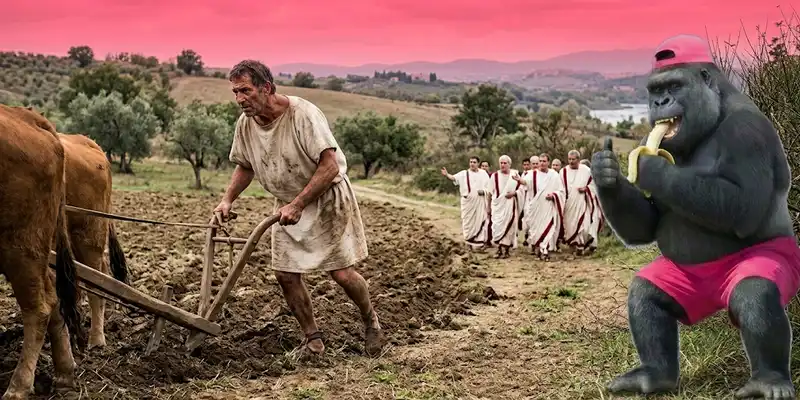
Rome, 458 BC. The Republic is falling apart.
The Aequi have trapped an entire Roman army in the hills. The Senate is in panic. The consuls have failed. The generals have failed. Everything that speed, power, and political ambition can throw at the crisis has been thrown — and it’s not enough.
So the Senate does something extraordinary. They cross the Tiber, walk into the countryside, and find a farmer.
His name is Lucius Quinctius Cincinnatus. He’s been ploughing his field. When the delegation arrives, he’s covered in dirt, working his four acres by hand. They ask him to put on his toga. They tell him he’s been appointed Dictator of Rome — absolute power over the entire Republic.
He fixes the crisis in fifteen days. Defeats the enemy. Saves the trapped army. Then he does the thing that made his name immortal.
He resigns. Gives back absolute power. Walks home. Picks up his plough.
And goes back to farming.
by David Anttony
The trillion-dollar AI arms race is built on cortisol — real-time inference servicing a neurochemical itch, not a business need. No business decision is made in two seconds. The companies that will thrive in the next five years aren’t the ones with the fastest AI — they’re the ones with the deepest first-party data. Like Cincinnatus, who fixed Rome in fifteen days because he already knew the answer from years of working his field, the competitive advantage isn’t speed — it’s the patient accumulation of data that compounds in value. Batch processing, off-peak compute, and overnight analysis cut costs by 40-50% while delivering answers that are just as good by morning. You don’t need a bigger army. You need to know your soil.
What the farmer knew
Here’s the thing about Cincinnatus that most people miss when they tell this story.
He didn’t fix Rome in fifteen days because he was fast. He fixed it because he already knew. The years in that field weren’t exile. They were preparation. He knew the terrain. He knew the soil. He understood the rhythms of things that grow slowly — seasons, harvests, the patient accumulation of knowledge that only comes from working the same ground, year after year.
When Rome came to him, he didn’t need to study the problem. He’d already lived it. The answer was in his hands before they asked the question.
Speed had nothing to do with it.
Cincinnatus didn’t win with a bigger army. He won because he knew his land better than anyone alive.
I’ve been thinking about this story for two years. And I’ve finally worked out why it won’t leave me alone.
It’s because the entire AI industry — the trillion-dollar, venture-backed, cortisol-fuelled race to build faster, bigger, more expensive intelligence — is running in exactly the opposite direction from the man who actually solved the problem.
The cortisol economy
There’s a reason everything feels urgent right now. And it’s not because it is.
When you swipe your phone, your brain releases dopamine — the reward chemical. When you’re waiting for a page to load, cortisol spikes — the stress hormone. When something unexpected appears, norepinephrine fires — the novelty signal. This is the neurochemical cocktail that social media was designed to exploit. Anticipation. Reward. Repeat.
Now look at the AI industry.
Real-time inference. Instant answers. Sub-second responses. The entire business model is built on the same neurochemistry. Cortisol while you wait. Dopamine when the answer arrives. The whole infrastructure — the GPU clusters, the data centres consuming 12% of all US electricity, the seven-year grid waits in Northern Virginia — exists to service a neurochemical itch.
Not a business need. An itch.
The question nobody’s asking is devastatingly simple: when did you last make a business decision in under two seconds?
Your quarterly strategy doesn’t update every 300 milliseconds. Your marketing budget isn’t allocated in real time. The question that actually keeps you up at night — how do I grow this business by 30% next year? — doesn’t have a two-second answer. It has a two-week answer. Maybe a two-month answer. And the quality of that answer depends entirely on the quality of the data underneath it.
Not the speed. The quality.
We’ve built a trillion-dollar industry servicing a drug. And the drug isn’t even useful for the thing that matters most.
The army behind the hill
While the AI arms race was burning through capital at a pace that would make a Roman emperor blush, one company did something very different.
It ploughed its field.
Apple spent the last decade building silicon. Not AI models. Not chatbots. Not cloud inference. Silicon. Chips. The M-series architecture — unified memory, low power, everything on one piece of glass. The kind of boring, patient, deeply unsexy hardware work that doesn’t get keynote applause at AI conferences.
Their AI assistant, Siri, was actually ahead of its time. Launched before the generative AI wave, it positioned Apple as an AI company before anyone was using that phrase. But it stumbled. The technology wasn’t mature. The data wasn’t there yet. And Apple — a company that prizes product quality above everything — pulled back rather than ship something half-baked.
The industry called it failure. Analysts called Apple’s AI strategy a “disaster” and warned they were one to two years behind competitors.
And Silly Siri was born.
Here’s what happened next.
Apple posted a $109.4 billion quarter. Record revenue. Record profit. Its Mac line hit $10.4 billion in a single quarter. AI labs — including the very companies calling Apple a failure — started buying tens of thousands of Mac minis and Mac Studios to run their own workloads. One of the leading AI companies started renting Mac hardware through AWS.
And the market still doesn’t get it. Analysts look at Apple’s numbers and see zero AI revenue. What they miss is that Apple doesn’t need AI revenue — everyone else is already paying Apple to run theirs.
Apple just posted its best fiscal year ever — without a single dollar of AI-driven revenue. No AI hype. No frontier model. No arms race. Just the best hardware on the planet, sold to everyone from creative studios to AI labs, powered by unified memory architecture that lets the CPU, GPU, and Neural Engine share one pool of RAM.
While every other company was spending fortunes to build bigger data centres, Apple was quietly building something far more dangerous: the best field in the world. And letting everyone else plough it for them. Apple Silicon.
That’s Cincinnatus. He didn’t command an army. He went home and worked his land. And when the crisis came, the army came to him.
The constraint that flipped
I started in IT at sixteen. COBOL. Green screens. Overnight batch jobs that ran for fourteen hours because compute was scarce and you queued for your slot.
We didn’t call it a strategy. We called it Tuesday.
Payroll. Inventory. Reports. Everything processed overnight, waiting on your desk by 9am. Nobody complained. Nobody needed it faster. The business ran on the rhythm of preparation — you set up the job five days ahead because you knew exactly when you’d need the answer.
Then silicon got cheap. Cloud got elastic. Speed became the flex. And overnight batch was suddenly for people who couldn’t afford better.
Except here’s the twist. The constraint flipped — and almost nobody noticed.
In the 1980s, compute was scarce. We solved that.
In the 2000s, bandwidth was scarce. We solved that.
In 2026, the scarce resource is power. Electricity. The physical watts required to run the machines. Data centres are on course to consume six times their 2018 share of US electricity. The biggest AI companies aren’t waiting for better chips. They’re waiting for grid connections.
And the solution to a power-scarce world is exactly the same solution we used in a compute-scarce world forty years ago.
Run it overnight. Use what you have. Wake up with the answer.
The grandpa’s method isn’t a relic. It’s the future. The constraint changed, but the wisdom didn’t.
Know your soil
So here’s where this lands for you — the person reading this who runs a business, manages a team, or makes decisions that need to be right more than they need to be fast.
You don’t need better AI.
You need better data.
Everyone is chasing the model. The speed. The inference. The trillion-dollar arms race where pricing is collapsing so fast that one AI company cut its prices by 67% and another slashed rates by 70-80% — and they’re still losing money hand over fist.
But Cincinnatus didn’t win with a bigger army. He won because he knew his land.
Your land is your data. The record of every transaction, every customer interaction, every campaign, every conversion. The first-party, server-side data that tells you — with certainty, not guesswork — what happened, why it happened, and what’s likely to happen next. Giving you the data clarity to make decisions that will drive your company ahead for years to come.
One great decision based on data is better than anything else.
The analysis that turns that data into intelligence? It doesn’t require a $150,000 GPU cluster. It doesn’t require real-time inference. It requires a decent machine with enough memory to hold your dataset, four patient hours overnight, and the wisdom to know that the answer will be there in the morning.
Shifting non-urgent compute to off-peak windows can cut your power costs by up to 40%. Batch inference from AI providers costs up to 50% less than real-time requests. The only thing you trade is a few hours of waiting for something you weren’t going to act on until the next meeting anyway.
That’s not a compromise. That’s a strategy.
The strategy of a farmer who knows his soil so well that when the question comes, the answer is already in the ground.
Plant the tree
The businesses that will thrive in the next five years aren’t the ones with the fastest AI. They’re the ones with the deepest data.
Data is soil to a farmer. The deeper the soil, the deeper the roots will naturally dive down to.
What Seresa calls Data Trees — data that compounds in value the longer it grows — is the modern equivalent of Cincinnatus’s field. You can’t harvest fruit from trees you didn’t plant. And you can’t analyse data you didn’t collect.
The Polymath Website — the six-layer stack that separates businesses built for an AI-first world from ones that aren’t — has data as its foundation. Layer six. Not a feature. Not an add-on. The bedrock. Because every other layer — your content, your visibility, your AI readiness — depends on knowing your soil.
And knowing your soil takes time. Patience. The willingness to plough the same ground, season after season, until you understand it so deeply that when the crisis comes — when the question arrives that could change the trajectory of your business for the next decade — you don’t need to panic. You don’t need to pay a fortune for a millisecond answer.
You already know.
Because you’ve been in the field.
The harvest
Business decisions are not made in milliseconds. They’re made slowly, over days, based on core data, core feeling, core experience. A single decision — the right one, made with the right information — can drive a company forward for years.
And when the data is solid, when you’ve collected it properly, when you’ve given it time to grow — it delivers its gold by the ton.
You don’t need a GPU cluster. You don’t need real-time inference. You don’t need to chase the cortisol hit of instant answers to questions that deserve slow, careful thought.
You need to know your soil. You need to plant your data. And you need the old wisdom — the Cincinnatus wisdom — to understand that the most powerful person in the room isn’t the fastest. It’s the one who already has the answer, because they’ve been preparing for the question their entire life — because they collected all the data their company needed for its future success.
They found him ploughing.
Where will they find you?
Start Planting Your Data Trees
The harvest doesn’t come from the model. It comes from the soil.
Transmute Engine™ is the data layer that collects, processes, and grows your first-party data — server-side, yours to keep. Every transaction, every interaction, every conversion. Planted today, compounding tomorrow.
No credit card. No commitment. Full access for 30 days.
Lock in a Lifetime fixed price now while it lasts!
Learn more about Transmute Engine™ →
P.S. My prediction? Apple will lead the AI race. Not because they built the best model — but because they built the best field to grow it in. The company that everyone said was behind just posted its best year ever, became only the second company in history to close above $5 trillion, and they did it without a single dollar of AI revenue. Cincinnatus never announced he was coming. Neither did they. And now Jensen from NVIDIA is “on the loose” — Cook + Jensen would make an interesting new company, wouldn’t they!
P.P.S. Already collecting data but overwhelmed by what to do with it? Start with the foundation — The Polymath Website: A New 6-Layer Stack for 2027 — and find which layer is your gap. The answer is usually closer than you think. And in the meantime, while you’re waiting — deepen your data soil. Collect more first-party data you own with our Harvest Plan. Plant your first Data Tree today →
This article was co-written by Claude AI + David Anttony. The thinking is human. The typing had help.
Key Takeaways
- Data beats speed: No business decision is made in two seconds. The quality of the answer depends on the quality of the data, not the speed of inference.
- The constraint flipped: In the 1980s compute was scarce; in 2026 power is scarce. The solution is the same — batch processing, overnight runs, wake up with the answer.
- First-party data is your soil: The record of every transaction, interaction, and conversion — server-side, yours to keep — is the competitive advantage no model can replace.
- Batch saves 40-50%: Shifting non-urgent compute to off-peak windows cuts power costs by up to 40%, and batch inference from AI providers costs up to 50% less than real-time.
- Data compounds: Data Trees — data that grows in value the longer it’s collected — are the modern equivalent of Cincinnatus’s field. You can’t harvest what you didn’t plant.
- Know your soil: The businesses that thrive in the next five years won’t have the fastest AI. They’ll have the deepest data.
AI model pricing is collapsing — companies have cut prices by 67-80% and are still losing money. The model is becoming a commodity. First-party data — the record of every transaction, customer interaction, and conversion collected server-side — is the competitive advantage no model can replace, because it compounds in value the longer you collect it.
The AI industry’s business model is built on the same neurochemistry as social media: cortisol while you wait for a response, dopamine when the answer arrives. Real-time inference and sub-second responses service a neurochemical itch, not a business need — no meaningful business decision is made in under two seconds.
Shifting non-urgent compute to off-peak windows can cut power costs by up to 40%. Batch inference from AI providers costs up to 50% less than real-time requests. The only trade-off is a few hours of waiting for something you weren’t going to act on until the next meeting anyway.
In the 1980s compute was scarce; in the 2000s bandwidth was scarce. In 2026, the scarce resource is power — the physical watts to run the machines. Data centres are on course to consume six times their 2018 share of US electricity, and the biggest AI companies are waiting for grid connections, not better chips.
Data Trees are data assets that compound in value the longer they grow — first-party, server-side records of transactions, interactions, and conversions that become more useful over time. You can’t analyse data you didn’t collect, just as you can’t harvest fruit from trees you didn’t plant. Starting data collection now creates a deepening competitive advantage.
The Polymath Website is a six-layer stack that separates businesses built for an AI-first world from ones that aren’t. Data is its foundation — layer six. Not a feature, not an add-on, the bedrock. Every other layer — content, visibility, AI readiness — depends on knowing your data soil.