
We’ve Created a PIPE You Will NEVER Smoke
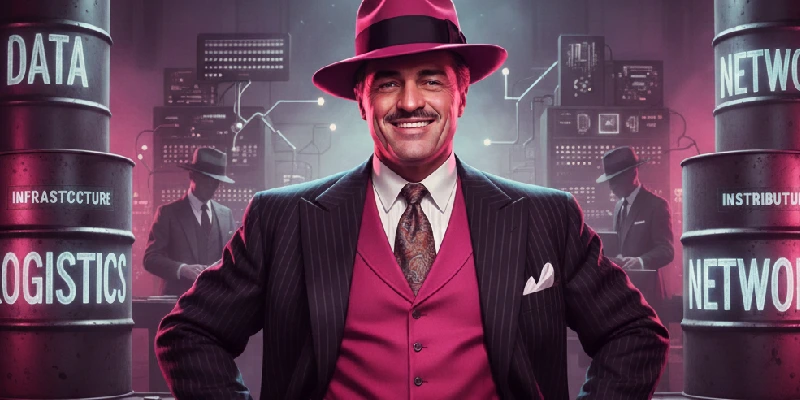
The infrastructure that becomes impossible to eliminate
Chicago, 1925. Smoke hangs thick in a backroom on South Wabash Avenue. A man in a tailored suit leans across a table littered with ledgers. He’s not looking at the whiskey. He’s looking at maps.
Routes. Warehouses. Delivery schedules. Distribution.
Al Capone understood something that his competitors didn’t: the whiskey was never the business. The pipeline was the business. While rival gangs fought over distilleries and bootleggers squabbled about product quality, Capone was quietly buying up the infrastructure — the trucks, the speakeasies, the network of corrupted officials who kept goods flowing through the city like blood through veins.
His competitors wanted to “smoke” his operation — gangster slang for eliminating the competition. But here’s the thing: you can’t kill what keeps the whole city drinking.
The infrastructure had become too valuable to destroy.
The Bruno and Pablo Problem
There’s an old parable about two brothers in a village that needed water from a distant spring.
Bruno grabbed buckets. Every day, he hauled water back to the village. He got paid per trip. He worked hard, he got results, and he scoffed at his brother Pablo, who spent months digging and laying pipe instead of earning money.
The villagers laughed. “Pablo’s wasting his time. Bruno’s getting rich.”
Then the pipeline was finished.
While Bruno was still hauling buckets at dawn — back aching, hands blistered, earning the same per-trip rate he always had — Pablo was sitting in the shade watching water flow continuously into the village. The same water. The same value. But Pablo’s infrastructure did the work while he focused on what came next.
Bruno was exhausted. Pablo was free.
Here’s the twist: in 2025, most businesses are still Bruno. They’re hauling data in buckets — manually exporting reports, copying numbers between platforms, paying consultants to extract insights one trip at a time. They’ve bought the AI whiskey everyone’s talking about… but they have no distribution network to move it.
And now? Everyone’s jumping on the agent wagon.
“AI agents will handle everything!” the headlines scream. “Autonomous systems that think, decide, and act!” Agents are the hottest trend in tech — autonomous AI that can browse, analyze, execute, and supposedly replace entire workflows.
Here’s what nobody’s asking: What do those agents actually work with?
Agents aren’t magic. They’re software that needs inputs. Clean, structured, reliable inputs. An agent can’t analyze customer journeys if the journey data is scattered across five platforms, sampled by GA4, and half-blocked by Safari. An agent can’t optimize your ad spend if it can’t see which ads actually drove conversions. An agent can’t make decisions if it’s fed garbage — or worse, nothing at all.
The Romans built aqueducts 2,000 years ago. We still use pipelines for water, oil, gas, and data. Pipelines aren’t sexy. They’re not “autonomous.” They don’t make headlines at tech conferences.
But they work.
Agents are the shiny new speakeasy. Pipelines are what keep the whiskey flowing to them. One is a trend. The other is infrastructure that’s been proven across centuries, across industries, across every technological revolution we’ve ever had.
The businesses betting everything on agents while ignoring pipelines? They’re buying empty speakeasies and wondering why nobody’s drinking.
AI Is Today’s Speakeasy
Everyone wants in.
The statistics are staggering. According to KPMG, the AI market is projected to grow 25-fold — from $189 billion in 2023 to $4.8 trillion by 2033. Ninety-two percent of companies plan to increase their AI investment over the next three years. Executives are treating AI like it’s the only game in town.
But here’s what they’re discovering: AI without data infrastructure is an empty speakeasy.
Gartner predicts that through 2026, organizations will abandon 60% of AI projects due to lack of AI-ready data. Not because the AI was bad. Not because the use case was wrong. Because the pipeline to feed it was never built.
The RAND Corporation puts it even more starkly: over 80% of AI projects fail — twice the failure rate of non-AI technology projects. And what’s the primary culprit? Data quality, data availability, and the infrastructure to deliver it.
Let that sink in.
Everyone’s buying the whiskey. Almost nobody has built the distribution network.
The Pacesetters Know Something You Don’t
Cisco’s 2024 AI Readiness Index revealed a 56-point gap between “Pacesetters” — organizations successfully deploying AI at scale — and everyone else.
What separates them?
97% of Pacesetters deployed AI at the speed and scale necessary to realize ROI. Only 41% of other organizations managed the same. The difference wasn’t the AI tools they chose. It was whether they had the infrastructure to feed those tools reliable, continuous, clean data.
Only 13% of all organizations are ready to leverage AI to its full potential. The other 87%? They’re Bruno, hauling buckets, wondering why the AI they bought isn’t transforming their business.
Here’s what Pacesetters understand: the AI race isn’t won by whoever adopts ChatGPT first. It’s won by whoever builds the pipeline that makes AI useful — not once, not occasionally, but continuously, automatically, at scale.
The $70,000 Confusion
Most small business owners hear “data pipeline” and immediately think: “That’s enterprise stuff. That’s for companies with data engineers and six-figure analytics budgets.”
That used to be true.
Enterprise solutions like Segment, mParticle, and Tealium cost $50,000 to $500,000 per year. That’s serious money for infrastructure most SMBs assumed they’d never need.
But here’s what changed: AI democratized the use of data before most businesses had democratized the collection of data. Suddenly, a WordPress site owner can ask an AI to analyze their customer journeys — but they can’t, because the data is scattered across GA4 (which is sampled), Facebook Ads Manager (which shows you what Facebook wants you to see), and a dozen disconnected spreadsheets.
They bought the speakeasy. They forgot to build the supply route.
According to Informatica’s CDO Insights 2025 survey, the top obstacles to AI success are data quality and readiness (43%) and lack of technical maturity (43%). Notice what’s not on that list? “We couldn’t afford good AI tools.”
The tools aren’t the problem. The pipes are the problem.
What a Real Data Pipeline Actually Does
Capone’s distribution network didn’t just move whiskey. It ensured whiskey moved — reliably, consistently, to every speakeasy in his territory. No empty shelves. No broken supply chain. No single point of failure that competitors could exploit.
A data pipeline does the same thing for your business intelligence.
Consider what happens without one: A visitor lands on your WordPress site. They browse three products, read two blog posts, sign up for your newsletter, and three weeks later, purchase something. Between those touchpoints, data scatters like dandelion seeds:
- GA4 captures some pageviews (but samples the data for reports)
- Your email platform tracks the signup (but doesn’t know about the product views)
- Facebook Pixel fires (but browser privacy features block 30-40% of events)
- Google Ads claims conversions (that may or may not overlap with Facebook’s claims)
- Your actual sale sits in WooCommerce, disconnected from the marketing data that preceded it
When you ask AI to analyze this customer’s journey, you’re asking it to piece together a puzzle where half the pieces are missing and the rest don’t match.
A pipeline changes everything. It captures every event at the source — server-side, before browsers block anything — and routes that data to every endpoint simultaneously. Same event, same data, same timestamp. GA4, Facebook CAPI, Google Ads, BigQuery. Everything connected. Nothing lost.
The AI doesn’t have to guess anymore. It has a complete picture.
The “Data Trees” You Never Planted
Here’s the cruel irony of the AI revolution: you can’t backfill data you never collected.
The businesses planting what we call “Data Trees” (coined by Seresa) today — building systematic data collection infrastructure — will harvest years of insights when AI gets sophisticated enough to use them. The businesses waiting will show up in 2027 with hungry AI systems and empty warehouses.
S&P Global’s 2025 research found that 42% of companies abandoned most of their AI initiatives this year, up dramatically from 17% in 2024. They didn’t abandon AI because it doesn’t work. They abandoned it because they discovered — too late — that they didn’t have the data foundation to make it work.
Every day you wait to build the pipeline is another day of data you’ll never get back.
Think about it: what if Capone had tried to build his distribution network after Prohibition ended? The opportunity would be gone. The infrastructure had to be in place before it was urgently needed.
The Nord Stream Problem: Pipelines Are Hard
September 2022. Three explosions rip through the Baltic Sea. In minutes, the Nord Stream pipelines — a $20 billion infrastructure project that took over a decade to build — become the world’s most expensive scrap metal.
Critical infrastructure is exactly that: critical. It’s also incredibly difficult to build, maintain, and protect.
The same is true for data pipelines. This isn’t “install a plugin and forget it” territory. A real data pipeline requires:
- Constant API monitoring — Google, Meta, and other platforms change their APIs regularly. What worked yesterday throws errors tomorrow.
- Server infrastructure — Someone has to provision, maintain, secure, and scale the servers that process your events.
- Queue management — Events need to be buffered, retried on failure, and processed in order. One hiccup can cascade into data loss.
- Format translation — GA4 expects data structured one way. Facebook CAPI expects another. Google Ads, another still. Someone has to maintain those translations.
- Security hardening — Your customer data flowing through infrastructure means that infrastructure needs protection. HMAC authentication, encryption, access controls.
- Monitoring and alerting — When something breaks at 3am, someone needs to know. And fix it.
This is why enterprise solutions cost $50,000-$500,000 per year. They’re not just selling software. They’re selling operational burden transfer.
Here’s what happens when businesses try to DIY their data pipeline: We’ve watched AI confidently promise to “build that for $20/month” — then watched the scope creep from a simple script into Redis queues, MongoDB databases, worker processes, retry logic, health checks, and suddenly the business owner is debugging Node.js at midnight instead of running their business.
We wrote about that exact scenario in When AI Says “I Can Build That!” — a cautionary tale of good intentions meeting operational reality.
The truth? Pipelines are best outsourced to specialists who do nothing else.
You don’t build your own power plant. You don’t lay your own fiber optic cables. You don’t maintain your own cell towers. You outsource critical infrastructure to people whose entire business is keeping it running.
Data pipelines are no different.
The PIPE You’ll Never Smoke
Gangsters wanted to “smoke” Capone’s operation — eliminate it, destroy it, make it disappear. But they couldn’t, because too much depended on it. The speakeasies needed supply. The city needed its vice. The infrastructure had become too valuable to eliminate.
That’s what a proper data pipeline becomes for your business.
Once you’ve built the system that captures every customer interaction and routes it where it needs to go — once you can ask AI questions and get real answers based on complete data — once your marketing decisions are driven by actual attribution instead of platform guesswork…
You’ll never go back to buckets.
And when someone else handles the maintenance, the API changes, the server scaling, the 3am alerts? You won’t want to go back. Ever.
Transmute Engine™ was built for exactly this moment — and exactly this problem. It’s a WordPress-native pipeline that captures events server-side — before browsers block them, before privacy tools strip your UTM parameters, before your attribution disappears into the gap between what happened and what GA4 decides to show you.
Every event flows to every destination: GA4, Facebook CAPI, Google Ads, BigQuery. Same data. Same format. Complete picture.
And here’s what matters most: the data flows to your BigQuery warehouse. Not Google’s. Not Meta’s. Yours. Every customer interaction, every conversion path, every piece of the puzzle — sitting in infrastructure you control, ready to feed whatever AI tools you deploy today or discover tomorrow.
The pipeline that nobody wants to eliminate. The infrastructure that compounds in value. The data trees that bear fruit for years.
Build your pipeline. Feed your AI. Become a Pacesetter.
Learn More About Transmute Engine™ → Get started for free!
P.S. Already collecting data but overwhelmed by what to do with it? Discover how to harness BigQuery without SQL expertise using natural language queries. The pipeline is just the beginning.
P.P.S. Curious what AI starvation looks like from AI’s perspective? We explored that in Who Stole AI’s Dinner? — the surprisingly relatable tale of an AI that sat down to eat and found nothing on its plate.