
John was 27 when he started his AI company. Hot, knowledgeable, and moving fast. Within a year he had a team of twelve running on adrenaline and belief. Within five years he’d hit $50 million in revenue. By year seven, he was ready to cash out.
Then the accountants arrived.
“Beautiful company,” they said. “Solid revenue. Great retention. But where’s your data?”
John blinked. “What do you mean? It’s in our systems.”
“Which systems? Your CRM has names and emails. Your analytics has sampled data with gaps everywhere. Where’s the complete customer journey data? The behavioral patterns? The first-party data an acquirer can actually use?”
The accountants wrote two numbers on the whiteboard. The difference was $23 million.
“That’s what your missing data is worth,” they said. “Twenty-three million dollars you would have had if you’d clicked the button that said COLLECT ALL THE DATA HERE seven years ago.”
And you know how the rest of the story goes.
John sold the company for less than it should have been worth. The acquirer immediately implemented complete data infrastructure. “This should have been here from day one,” their CTO said during transition.
John just nodded.
He knew.
The Pattern Hidden in Plain Sight
Here’s the thing about John’s story — it’s not really about John at all.
It’s about a pattern that shows up everywhere. A pattern so consistent it’s almost mathematical.
“Give me a child until he is seven, and I will show you the man.” — The Jesuits knew. The first seven years shape everything that follows.
The Seven-Year Itch in relationships. That restless moment around year seven when couples either recommit or walk away.
The cell regeneration myth — the belief that every cell in your body replaces itself every seven years. Not quite true biologically, but the average is 7-10 years.
Even mathematics obsesses over seven. Divide 1 by 7 and you get 0.142857142857… repeating forever. Multiply 142857 by anything from 1-6 and the digits just rotate. Multiply by 7? You get 999999. The digits add up to 27, which reduces to 9.
The Pythagoreans called seven “Minerva” — virginal, unmothered, unfathered. The only number from 1-10 that neither comes from multiplication nor produces another number in the decade when multiplied.
Seven stands alone.
And business cycles? They follow the same pattern.
The Two Seven-Year Cycles Every Business Lives
Years 0-7: The Chaos Cycle
Pure survival mode. Cash flow is oxygen. Structure doesn’t exist yet. Every dollar, every hour, every ounce of energy goes into one thing: not dying.
Data collection? “We’ll worry about that later. Right now we need to survive.”
Organized metrics? “Revenue — that’s our metric. Did we make payroll? Good. Next.”
In the chaos years, nobody cares about data. And honestly? It makes sense. You’re firefighting. You’re building. You’re growing. Who has time to set up data infrastructure when you’re trying to keep the lights on?
Years 7-14: The Manager Cycle
If you survive year seven — and only 35% of businesses do — something shifts.
The managers arrive. They want structure. Process. Measurement. They ask reasonable questions: What’s our customer acquisition cost? Which marketing channels perform best? What’s our conversion path look like?
And the founders stare blankly.
Because the data doesn’t exist.
The managers arrive hungry, but the table is empty.
So they spend the next seven years trying to build the data infrastructure that should have been there from day one. Capturing data going forward. Waiting long enough to have meaningful historical patterns.
It takes another full seven-year cycle to build the foundation the managers need.
Historically, that was fine. You had time.
In the AI age? You’re dead by year 10 if you don’t have data by year 7.
The Balance Sheet Revolution Nobody’s Talking About
Let that sink in for a moment.
In 2025, when accountants value a company, they look at physical assets, intellectual property, and brand value. Brand — that intangible thing made of reputation and recognition — now sits on balance sheets as a quantifiable asset. Sometimes worth more than the physical assets combined.
But here’s what’s wild: Who is putting data onto the balance sheet in 2025?
Almost nobody.
Data — the actual fuel that powers AI, the raw material that creates competitive moats, the asset that compounds in value every single day — isn’t being valued as an asset on most balance sheets.
Yet.
Seven years from now? I will guarantee large companies will have a line item for data as an asset. A real number. Audited. Valued. Treated with the same seriousness as real estate or equipment or brand equity.
And companies that started collecting in 2025 will have seven years of compounding value.
Companies that wait will have… nothing.
The itch you cannot scratch isn’t about seeing the present clearly. It’s about not seeing the future — even when the pattern is screaming at you from philosophy, mathematics, relationships, and every business cycle that came before.
Why “Later” Is Already Too Late
The statistics are brutal:
- 80% of AI projects fail (RAND Corporation)
- 60% of AI initiatives will be abandoned by 2026 due to lack of AI-ready data (Gartner)
- The #1 obstacle to AI success? Data quality and readiness — 43% of organizations cite this as their primary blocker
These aren’t technology failures. They’re data failures.
AI needs data to eat. No data, no dinner. No dinner, no growth.
And here’s where everything accelerates: The average S&P 500 company tenure in 1965 was 33 years. By 2025? It’s dropped to 12-15 years and falling fast.
Why? Because AI moves in months, not years.
Companies that used to have 14 years — two full seven-year cycles — to figure out their data infrastructure now have maybe 2-3 years before AI-native competitors eat their lunch.
The cycle didn’t change. The speed did.
The Itch You Cannot Scratch
John’s real mistake wasn’t ignoring data. It was believing he had time.
He thought data was something you’d deal with later, when the business was stable, when you had resources, when someone asked for it.
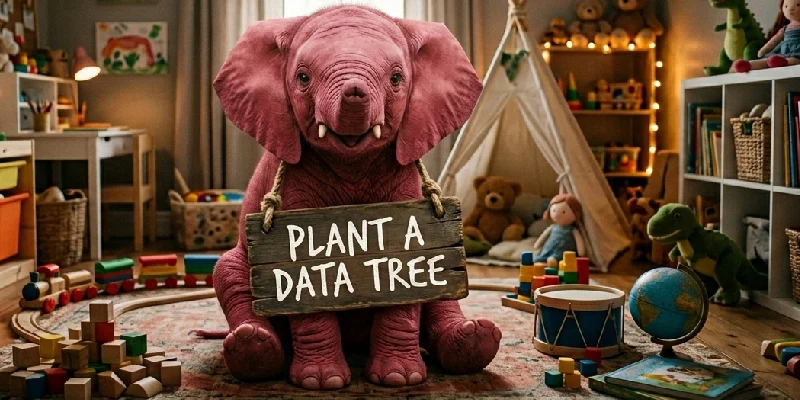
But you can’t backfill seven years of customer interactions. You can’t reconstruct behavioral patterns that were never captured. You can’t plant Data Trees (as we call them at Seresa) after the harvest season has passed.
The seven-year itch you cannot scratch is the data you never collected.
And when you want to sell? When you’ve built something worth acquiring and you’re ready to cash out?
It’s staring at a valuation that should have been $23 million higher and realizing the only thing you needed to do — the only thing — was click a button seven years ago that said “capture this data.”
That’s the itch. The one that comes at year seven when you finally have the clarity to see what you should have done at year one.
And by then, it’s too late.
The Twist: This Actually Isn’t Complicated
Here’s the twist nobody tells you: planting Data Trees doesn’t require enterprise budgets or technical expertise or months of implementation.
It requires deciding to do it before it’s urgent.
With something like Transmute Engine™, you can:
- Install a WordPress plugin
- Add your platform API keys
- Watch data flow — to GA4, to Facebook, to Google Ads, to your own BigQuery warehouse
That’s it. Data flowing from day one. Captured. Stored. Compounding in value while you focus on survival, on growth, on all the chaos that defines years 0-7.
Then when year seven hits — when the managers arrive, when the acquirers come calling, when the AI needs feeding — you have something to give them.
Not an empty table.
A harvest.
The Question You Should Be Asking
The seven-year itch isn’t really about relationships. It’s not about cell regeneration or mathematical patterns or Pythagorean philosophy.
It’s about the gap between what you could have done at the beginning of a cycle and what you actually did.
The question isn’t: “Should I start collecting data?”
The question is: “What will my business look like in seven years if I don’t?”
In 2032 — and yes, those digits add up to 7 — data won’t just be valuable. It will be a line item on balance sheets. An asset with audited value. The difference between a company worth acquiring and a company worth forgetting.
The companies planting Data Trees today will have seven years of compounding value to harvest.
Everyone else will be staring at an empty orchard, scratching an itch that can never be relieved.
Plant your Data Trees today. The seven-year harvest won’t wait.
Learn More About Transmute Engine™ → — Start your free trial and begin collecting data before it’s too late.
P.S. Want to understand why AI keeps sitting down to an empty plate? Read Who Stole AI’s Dinner? — the uncomfortable truth about data starvation that nobody’s talking about.
P.P.S. Curious about whether your business will even exist in 2027? We wrote about that too: Will Your Business Have a Pulse in 2027? — spoiler: it depends on what you do today.