
Lithium or Salt? It’s 2047 Today.
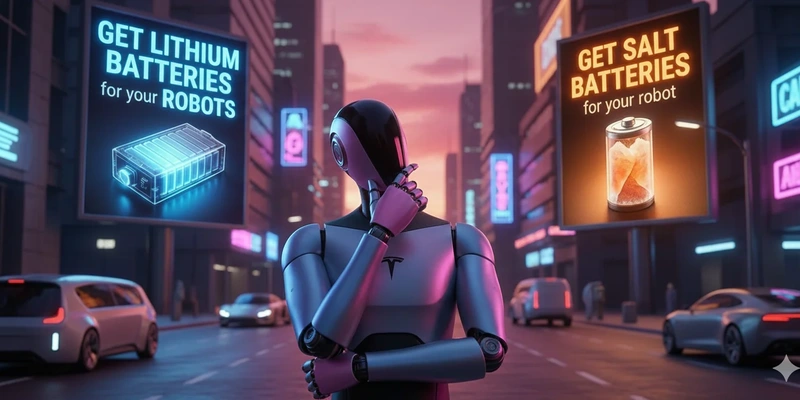
It’s Tuesday morning. You’re scrolling through supplier options for your new staff.
Not job boards. Not recruiters. Supplier catalogues.
The Model T-7s are on sale—$4,200 each, works out to about $3.50 an hour over their 18-month lifespan. Power included. No benefits, no sick days, no HR paperwork. The new T-8s drop next quarter but honestly, these are disposable. Like upgrading your laptop, not hiring your nephew.
The real decision this morning? Lithium or salt batteries. Lithium’s cheaper upfront but the salt ones last longer in the warehouse humidity. You make a note to ask the AI what last quarter’s maintenance data suggests.
Your AI. The one that runs customer service now. The one that is your website—greeting visitors like a concierge, closing sales while you sleep. The one that just flagged an opportunity because it noticed a pattern in your BigQuery data you’d never have spotted yourself.
You tap a query: “Show me conversion patterns from podcast mentions, last 90 days.”
Instantly, a breakdown. Which shows. Which hosts. Which episodes drove buyers who actually stuck around.
The business down the road—the one that laughed off “data pipelines” as tech nonsense back in 2025? They’re running the same AI. Same robots. Same tools.
But when their AI tries to answer that query?
“Insufficient data for this period.”
They started collecting in 2045. Twenty years late. They’ve got 24 months of information. You’ve got two decades.
Their AI is hungry. Yours is fed.
But No. It’s Not 2047.
It’s 2027. And everything you just read? It’s not science fiction. It’s 24 months away.
Most people think this is 2047 stuff. Robots for employees? AI running your website? That’s decades out, right?
Wrong. Sub-$10K humanoid robots are already in production. Operating costs under $4/hour are already the math. The only question is whether you’ll have the data infrastructure ready when they arrive—or whether you’ll be starting from scratch while competitors run laps around you.
And you’re reading this in 2025. On a website that still works the old way.
Static pages. Click here, scroll there, find the contact form buried in the footer. Stock photos of handshakes. A chatbot that says “I didn’t understand that, try rephrasing.”
That world is ending. Not slowly. Now.
The Hotel Lobby Internet
Remember the last time you walked into a good hotel? You didn’t wander around looking for signage. Someone greeted you. They knew your name because you booked ahead. They walked you through options, answered questions, handled the complexity behind the scenes.
That’s what websites become.
Not brochures. Conversations. An AI entity that knows your product better than your best sales rep, never sleeps, never has an off day, and guides every visitor like a concierge who’s been briefed on exactly who just walked in.
But here’s what the AI concierge needs to do its job: data.
Who just walked in? Have they been here before? What did they look at last time? What campaign brought them? What’s their intent?
No data, no concierge. Just another chatbot fumbling in the dark.
The Great Ad Collapse
By 2027, paid advertising as we know it won’t disappear. It’ll just stop working for most businesses.
AI intermediaries will answer questions before anyone clicks an ad. Google’s already doing it. ChatGPT’s already doing it. When someone asks “best CRM for small teams,” they’ll get an answer—not a list of ten sponsored links to click through.
The businesses that thrive won’t be the ones who bid highest. They’ll be the ones the AI recommends.
And how does an AI decide who to recommend? It reads the internet. It scans Reddit threads where real people say “we switched to X and it changed everything.” It listens to podcasts where a founder casually mentions the tool that solved their problem. It indexes conversations, not campaigns.
The new ad is someone talking about you when you’re not in the room.
This isn’t theory. Look at how buying decisions already happen:
- “Anyone used this tool?” gets posted in a Reddit community
- A podcast guest mentions something that fixed their problem
- A Reddit thread asks for alternatives and someone answers
That’s the ad now. Except it’s not an ad. It’s a data point that AI will use to decide who gets recommended.
The Gap Nobody’s Talking About
Most business owners in 2025 are worried about:
- “Should I post more on Instagram?”
- “How do I get more Google reviews?”
- “My website needs updating”
Meanwhile, the actual conversation coming at them:
- “Which LLM should run your customer service?”
- “What’s your data warehouse strategy?”
- “How do you train your AI workforce on your business specifically?”
- “Lithium or salt batteries for the robots?”
That’s not a 10% shift. That’s a different planet.
And most won’t make it across that gap. Not because they’re dumb. Because nobody’s translating for them. The tech world talks to itself. The average business owner hears “AI” and thinks “that chatbot that annoys me on websites.”
You Can’t Train an AI on Data You Didn’t Collect
Here’s the uncomfortable math.
In 2027, when your AI concierge needs to answer “what kind of customers convert best from podcast mentions?”—it will query your data warehouse.
If the data isn’t there, the AI will shrug. Not dramatically. Just… nothing.
“Insufficient data for this query.”
The polite way of saying: you didn’t plant this tree, so there’s no fruit to pick.
And here’s the thing about data: you can’t backfill it.
You can’t call up 2025 and say “actually, start tracking that.” You can’t reconstruct the customer journeys you never captured. You can’t teach your AI about patterns that were never recorded.
The businesses who start collecting clean, complete data now will have two years of training material when 2027 arrives.
The businesses who wait? They’ll arrive at 2027 with an empty warehouse and a hungry AI. And while their competitors are running intelligent, data-fed systems on day one—they’ll be starting from scratch.
“Check back in 18 months, the AI is still learning.”
That’s not a disaster. It’s just slow. Expensive. The kind of competitive disadvantage that compounds quietly until it’s obvious to everyone.
Your future AI doesn’t care about your excuses. It only knows what you fed it.
The Unsexy Truth
Nobody gets excited about data pipelines. There’s no TED talk called “How I Set Up Server-Side Tracking and It Changed My Life.”
But this is the picks-and-shovels moment of the AI gold rush. The unglamorous infrastructure work that separates the prepared from the panicked.
Right now, today, the move is simple:
Get your WordPress data flowing server-side to BigQuery. Clean. Complete. Untouched by ad blockers, browser privacy features, or the 40% data loss that client-side tracking guarantees.
This isn’t a technical upgrade. This is you building your new marketing muscle—not in 2027, but today. Right now. Data-first focus. Planting data trees.
Remember when Google announced “mobile-first indexing”? The businesses that moved early dominated. The ones who waited scrambled for years playing catch-up. Some never recovered.
This is that moment again. Except bigger.
The Spartans of marketing—the ones who actually win—they’re not debating whether to go data-first. They already have. They understand that “data-first” isn’t a strategy option anymore. It’s the new baseline. Like mobile wasn’t optional after 2015. Like having a website wasn’t optional after 2005.
Data Trees (coined by Seresa) that you own. Not Google. Not Meta. Not some ad platform that can change the rules tomorrow and lock you out of your own insights. You.
That’s the shift. The old marketing muscle was “how do I get more traffic?” The new marketing muscle is “how do I own more data?” Traffic is rented. Data is owned. Traffic disappears when the algorithm changes. Data Trees compound forever.
Your BigQuery warehouse isn’t just storage. It’s the foundation your AI will query. It’s the proof that your “worth talking about” moments actually moved the needle. It’s the asset that appreciates while everything else in marketing depreciates.
What Marketers Actually Do Now
Two things. Only two things matter anymore.
1. Create moments worth talking about.
Not campaigns. Moments. Experiences. Results so clear that customers mention you unprompted. This isn’t “brand building” in the fluffy sense—it’s engineering word-of-mouth at scale. Because that’s what AI will read. That’s what AI will recommend.
2. Own the data layer.
Everything else gets commoditized or automated. The ad platforms optimize themselves. The AI writes the copy. The websites run themselves.
But the data pipeline—the system that captures every interaction, every conversion, every signal, clean and untouched—that’s yours. That’s what feeds your AI concierge. That’s what proves which moments actually worked. That’s the foundation everything else runs on.
Marketers who don’t own their data will be guessing. Marketers who do will be knowing—and training their AI on reality instead of the 60% of reality that browser-based tracking happens to catch.
Transmute Engine – The Setup Takes Minutes. The Payoff Compounds for Years.
This isn’t complicated:
- Sign up on a monthly subscription (using Stripe, so it just works)
- Add your API keys for endpoints
- Data flows. WordPress to BigQuery and wherever else you want it—GA4, Facebook Ads, Google Ads, Klaviyo. Clean. Owned. Ready.
That’s it. That’s the whole thing.
The hard part isn’t the technology. The hard part is deciding to do it before it’s urgent.
It’s 2047 Today
That weird feeling you have? That sense that the rules are changing and nobody’s explaining how?
You’re not crazy.
Most people think the robot-and-AI future is 2047. It’s 2027. And that means the data infrastructure decision isn’t a 2026 problem. It’s a right-now problem.
The businesses that win in 2027 are building their data infrastructure in 2025. Not because they’re visionaries. Because they did the math.
Two years from now, you’ll either have a warehouse full of insights—or you’ll be explaining to your AI why it doesn’t know anything about your customers.
Lithium or salt? That’s a 2027 problem.
Data pipeline? That’s a today problem.
Start collecting!